Quiero bajar al pozo
quiero subir los muros de Granada
para mirar el corazón pasado
por el punzón oscuro de las aguas.
El niño herido gemía
con una corona de escarcha.
Estanques, aljibes y fuentes
levantaban al aire sus espadas.
¡Ay qué furia de amor! ¡qué hiriente filo!
¡qué nocturno rumor! ¡qué muerte blanca!,
¡qué desiertos de luz iban hundiendo
los arenales de la madrugada!
El niño estaba solo
con la ciudad dormida en la garganta.
Un surtidor que viene de los sueños
lo defiende del hambre de las algas.
El niño y su agonía, frente a frente
eran dos verdes lluvias enlazadas.
El niño se tendía por la tierra
y su agonía se curvaba.
Quiero bajar al pozo
quiero morir mi muerte a bocanadas
quiero llenar mi corazón de musgo
para ver al herido por el agua.
I want to go down to the well,
I want to go up the walls of Granada,
to watch the heart pierced through
by the dark thrust of water.
The wounded boy was moaning
under his crown of rime.
Pools, cisterns, fountains
raised their swords to the wind.
What a fury of love, what a wounding edge,
such nocturnal murmurs, such a white death!
Such deserts of light were crumbling
the sands of dawn!
The boy was alone,
the city asleep in his throat.
A water spout out of his dreams
wards off the hungry algae.
The boy and his agony, face to face,
were two green rains enlaced.
The boy stretched out on the ground,
and his agony bent over.
I want to go down to the well,
I want to die my own death, by mouthfuls,
I want to stuff my heart with moss,
to watch the boy wounded by the water.
Translated from the Spanish by Edwin Honig
<< Next >>

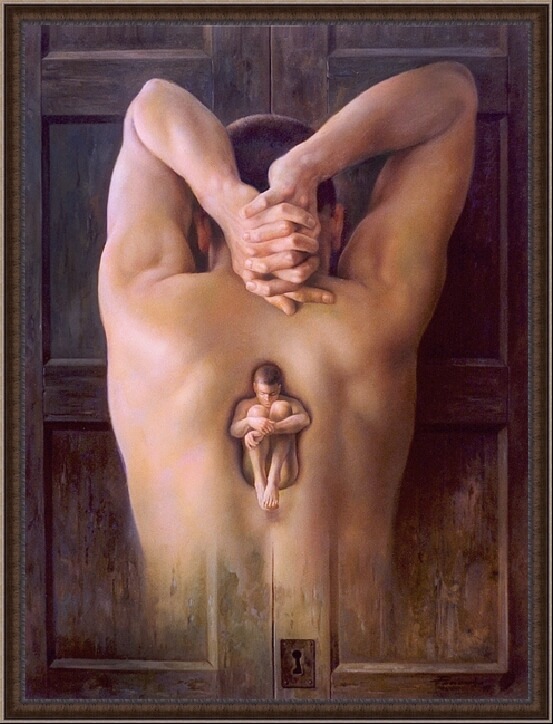
Pintura : Nina Terletsky. Los elementos. El agua
La traducción al ruso :
Федерико Гарсиа Лорка. Касыда о раненном водою
Хочу спуститься в глубь колодца,
хочу подняться лестницей крутою,
чтобы увидеть сердце,
ужаленное тёмною водою.
Теряя силы, бредил мальчик
в венке из инея и крови.
Ключи, колодцы и фонтаны
клинки скрестили в изголовье.
О вспышки страсти, всплески лезвий,
о белой смерти пение ночное!
О желтый прах сыпучего рассвета
среди пустыни зноя!
Один на свете, бредил мальчик
с уснувшим городом в гортани.
Прожорливую тину заклинало
приснившихся фонтанов бормотанье.
Агония дугою выгибалась
и, выпрямляясь, холодела.
Сплелись двумя зелёными дождями
агония и тело.
Хочу спуститься в глубь колодца,
и черпать смерти снадобье густое,
и впитывать её замшелым сердцем,
чтобы найти пронзённого водою..
Traducido al ruso por: Natalia Perelyaeva
Compartir en:
mir-es.com
Enviar
Para poder introducir tu opinión, debes rellenar obligatoriamente los campos señalados como *